The voodoo belief of zombies has been influencing media for decades. In the past voodoo "witch doctors" would make zombies. They would give puffer fish poison to people putting them in a near death state usually, and then later he would return to collect the so called corpse to make them do his bidding. He would give the person deliriant drugs to put the person in a detached state making it easier to make them do what they said and also make them appear to be mindless.
In 1936 the Federal Theatre Project's production of Macbeth they played a new twist on the traditional play hamlet where they had an all-African American cast which was a big deal for the times. They modified the script to fit to a voodooist theme like changing the witches’ imagery to make it fit more. The decision to make it voodoo themed was the by the producer Orson Welles as he felt people would find voodoo more credible then medieval witchcraft.
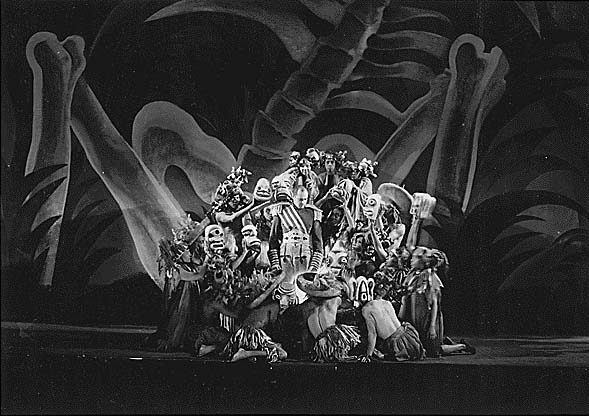 |
| Photo of the cast |
This i feel is a very important media piece for Voodoo because this was the first real example of Voodoo being portrayed in media especially in theatre one of the biggest forms of media at the time. It's made even more important due the fact of the choice of the black cast which was a thing that would be all but unheard on which made a gateway for Voodoo to enter media despite the fact it is a generally a "Black persons" belief.
In 1954 the United States Air Force tested there new jet fighter named the McDonnell F-101 Voodoo. The F-101 Voodoo was designed to be used by the USAF and the Royal Canadian Air Force shortly after World War II. It came into use during the Vietnam war to great effect as a reliable and cheaper jet fighter until it was eventually put out of service in the USAF in 1972 closely before the end of the war.
   |
| The various Voodoo models |
This is also important i think because it shows one of the first uses of the named Voodoo being used as if it’s a brand applied to a product which there are little to no examples of before this aircraft.
In 1954, Ian Fleming wrote "Live and Let Die". The book was a sequel to the popular casino royale in the James bond series. In the book the main foe of James Bond was Mr Big but he had a henchman called Baron Samedi. This was Baron Samedi is an entity of death in Haitian Vodou. He is not usually a vengeful or evil god as he is more of a debauchery type.
 |
| The book cover. |
This was a interesting choice i think to add Voodoo connotations into his work because i feel if he wrote 10 or so years before he wouldn't add anything Voodoo due to the correlation I’m feeling of early 50's being the core starting point of Voodoo being popular in media.
This is also the same for the film of the book released 1973 under the same name. This marked one of the main first times Voodoo really hit the mainstream as an interest in more modern cinema.
 |
| Baron Samedi from Live and Let Die |
 |
| Movie poster of Live and Let Die. |
I feel it’s obvious that they decided to make more of a point for the black cast and Voodoo film because of the film being released right in the height of Blaxploitation hitting Following Shaft which many believe kick start Blaxploitation in 1971
Strange Tales is a anthology published by Marvel Comics first published in 1951 featuring all sorts of different stories. One of the main stories featured first in 1973 is Brother Voodoo. This title was changed more recently into Doctor Voodoo in 2009. Brother Voodoo's story revolves around him going to Haiti and learning Voodoo practice from his village’s Voodoo priest. His powers revolve around using the power of the Loa who are Voodoo gods which is interesting because it plays on real fact in the comic which also spreads the knowledge of the history of Voodoo.
Strange Tales is a anthology published by Marvel Comics first published in 1951 featuring all sorts of different stories. One of the main stories featured first in 1973 is Brother Voodoo. This title was changed more recently into Doctor Voodoo in 2009. Brother Voodoo's story revolves around him going to Haiti and learning Voodoo practice from his village’s Voodoo priest. His powers revolve around using the power of the Loa who are Voodoo gods which is interesting because it plays on real fact in the comic which also spreads the knowledge of the history of Voodoo.
 |
| An issue of Brother Voodoo |
This example is good i think because it portrays Voodoo in a "Cool" way instead of a more typical belief system, not to mention the obvious choice of "Brother" in his name due to it being a cool phrase being said at the time to each other by black people. This i feel is important to note because i feel this is a good example of a major buisness seeing that Voodoo could be a profitable IP and being successful with it showing that even back then it was a good theme.
in 1990, Lucasarts released the game "The Secret of Monkey Island" there featured a charicter "Voodoo Lady" who features as a guide to the main charicter as she predicts the future for the player as well as giving him helpful items which feature a voodoo doll. The Voodoo Lady features in all five of the Monkey Island games acting in all as a guide throughout.
 |
| Picture of the "Voodoo" Lady" |
I think its intresting because of the unsual choice of a guide as almost all game feature some sort of guide player to help the player yet still keep the player emersed but personally i like the choice as it portrays a more mystic view on the guide. It is easy to see it plays on the belief of Voodoo practises being mysterious and all knowning.
I can see now i there seems to be a start to Voodoo being present in media around late 30's/40's but i feel it really came into effect in the 50's with a large increase in popularity which rose around the 70's in the height of Blaxploitation due to Voodoo being stereotypically a "Black" religion and therefore an interesting theme to portray at the time.
