In books there is "The Rats" (James Herbert 1974) which is a book about a giant rat infestation that begin to kill people. In the book people bitten by the giant rats die of a mysterious disease 24 hours later. This leads to a pandemic like infections from people getting bitten by the rats. Later the government try to fight back against the rats by using another virus back against the rats which in the end fails but at least neutralises the rat’s toxicity.
 |
| The books cover |
In 1983, The Uncanny X-Men had a series about the character apocalypse recruiting members to his "Horsemen of the Apocalypse" playing on the old mythical belief of the 4 horsemen who rule over when the end of the world will happen when they emerge forth. One of these characters who is recruited is named Plague who has the ability to absorb diseases being unaffected by them but modify them to be more deadly and spread them again by touch. She is originally an old woman but upon becoming one of the horsemen she goes through a major visual change while gaining a robot horse.
 |
| Plague before becoming a horsemen |
_001.jpg) |
| Plague after she becomes a horsemen |
There is a famous painting from the artist Arnold Böcklin done in 1898, from Switzerland that is currently being displayed in the Kunstmuseum in Basel. This painting is called "Böcklin" or "Plague" translated. This painting is very symbolic of war, disease and death. The painting portrays death swooping down taking lives at random. The painting is painted with a wide range of green colours which are symbolic of disease.
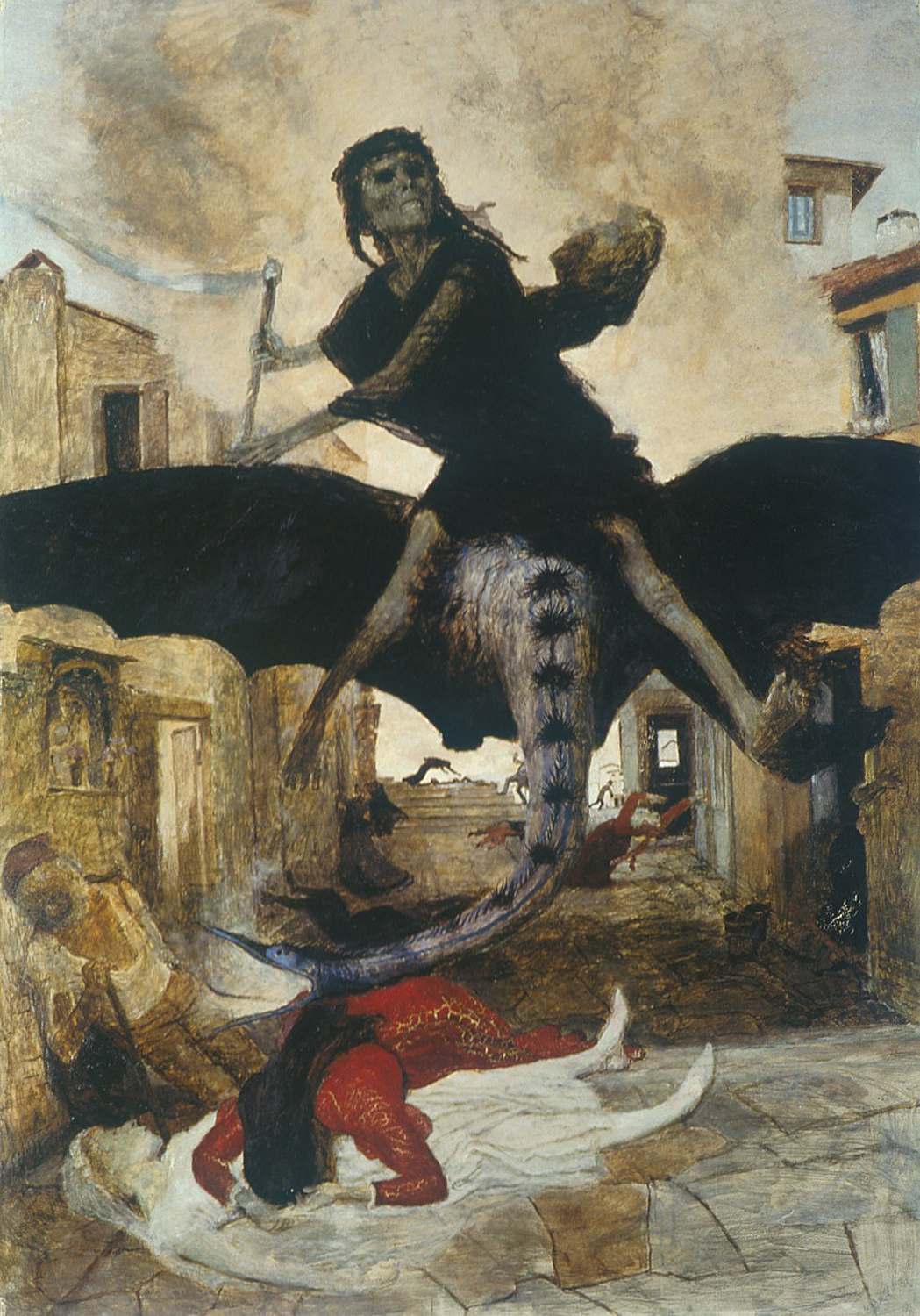 |
| Arnold Böcklin 1898 |
This painting i feel is good because it shows that even more then 100 years ago, plague and disease where very relevant in media mostly due probably because of the lack of greater health care leading to more deaths by disease. It's also interesting how striking the painting is with death bold in the centre with the dead scattered in his wake showing the inevitable and destructive nature that disease can be especially in old times of bad health care.
This painting is a old era painting dipicting the mass burials that where required due to the large amount of people the bubonic plague claimed everyday. This left a massive impact on people even after the Plague stopped being a problem, due to the catastrophic number of deaths involved over a age leading to near apocolypic levels if it wasnt stopped when it was. This unsurprisingly lead to a number of paintings dedicated to capturing the horror of the plague.
 |
| Painting depicting mass burials |
This painting i feel is a really good example because it is just one of hundreds of different paintings all on the same burial topic which shows the horror that was felt seeing hundreds get buried each day which did well to cement the link between pandemic and mass death which still lingers today as all have heard of the bubonic plague and how many it claimed keeping the fear of a pandemic still strong today.
In 1978, Edward Hunt directed a Canadian film called Plague or as it was titled internationally "M3: The Gemini Strain".
This film is about a genetic accident in a Canadian lab which accidently causes a very deadly strain of bacteria. As the deadly strain spreads killing millions, scientist Daniel Pilon works tirelessly trying to fix it.
 |
| International movie poster |
This film is good i think because it shows Plague being a theme in early cinema history as it was learned that the idea of disease scares humans so easily due to its invisible yet destructive nature. This also does well to show how the idea of a race against time to find a cure could be a interesting plot line which is later used more often.
This is a tapestry dating back to height of the bubonic plague as it was sweeping across England wiping out millions. This tapestry, like the painting depicting the mass burials that where going on at the time. This shows how much of a deep cultural impact this made as depictions of this where across different types of media in different forms.
 |
| Tapestry showing the mass burials |
This piece of tapestry i feel is a relevant media example i think because of the spread of different media types showing just how much the distress caused by disease had.
By looking through media examples of plague in the past i have seen that real life pandemics that have happened centuries ago can still have a big impact on our fear today as the media examples show the deep seeded effect it has on media and how it in turn makes new media with pandemics as the main horror plot.


No comments:
Post a Comment